
The Sustainable Hotel. Front of House, Anyway.
Hotels have made real progress on sustainability - refillable dispensers, recyclable straws. Walk past the lobby. The office hasn't changed.
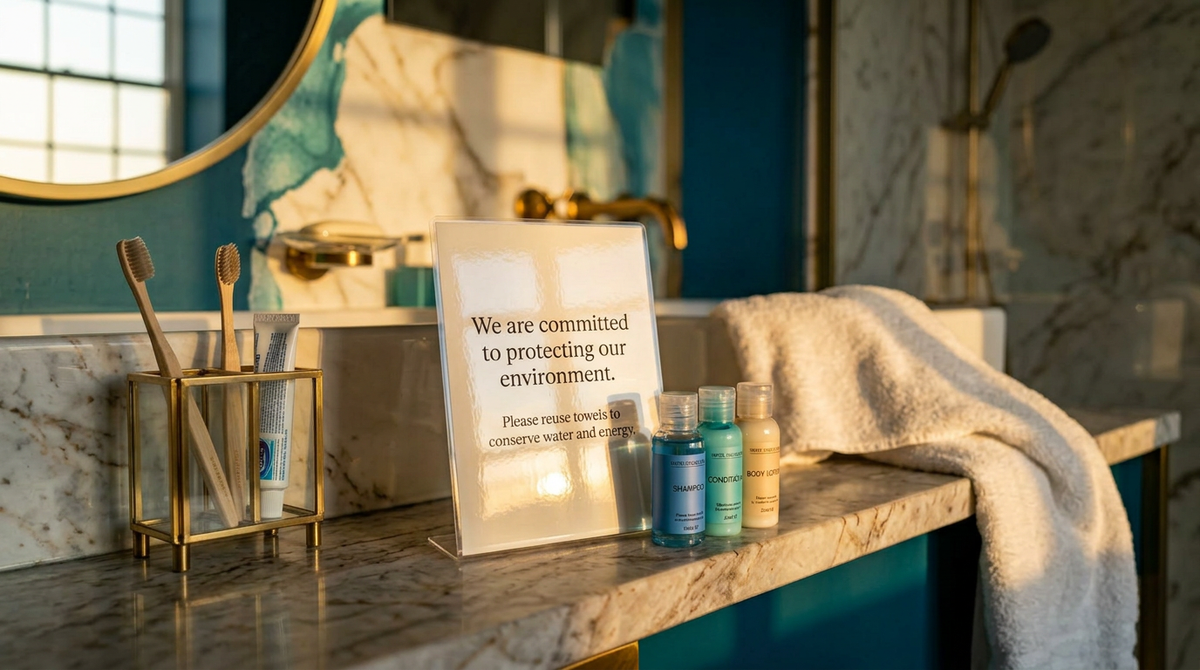
The recyclable straw arrived in your cocktail with a small card explaining the hotel's commitment to the environment.
The card was laminated…
Hospitality has been on a sustainability journey for the better part of a decade. And in the areas guests actually encounter, real progress has been made.
Refillable amenity dispensers have replaced single-use shampoo bottles. Recyclable straws. Compostable cups. Linen reuse programmes. Locally sourced menus. Motion-sensor lighting. Smart HVAC systems that stop the building from being cooled to 19 degrees at full blast while guests are at the pool. Temperature controls that prevent the chiller bill from going through the roof — though not every hotel has figured that part out yet.
Some hotels have gone further. Clean the World — operating with 8,599 hotel partners worldwide and processing nearly 1.5 million hotel rooms daily — collects partially used soap bars and plastic amenity bottles from guest rooms, recycles them and distributes them to communities in need across 127 countries. To date they have collected over 19 million pounds of soap, diverted more than 15.6 million pounds of waste from landfills and reduced the industry's carbon footprint by nearly 12 million kgCO2e. Other properties collect soap offcuts on property, remelt them and reform them into new bars shaped as small animals or local motifs — hygienic, zero-waste, and more memorable than anything a supplier catalogue ever produced.
Companies like Feelgoodz Hospitality are rethinking the guest amenity category from the ground up. Their in-room slippers and spa slides are sustainably sourced and artisan-crafted — made from materials including recycled rice husks, natural rubber tapped directly from trees, and repurposed plastic from grocery bags and bottle wrappers. The products are designed to be taken home rather than thrown away, keeping disposable slippers out of landfills entirely. Their spa range offers a reusable backbar option alongside a take-home amenity — the same item serving two purposes. Beyond the product itself, Feelgoodz works with Cham Pa weaving communities in Vietnam, preserving heritage craft traditions as part of their supply chain. They are a Forbes Travel Guide preferred vendor, with clients including The Ritz-Carlton, 1 Hotels, Maybourne and Conrad. It is a good example of what happens when a supplier builds sustainability into the product rather than attaching it as a label afterwards.
Some hotels have eliminated purchased bottled water entirely — filtering, purifying and bottling on site, served in reusable glass with the hotel's name on them. In India, even luxury properties are routing treated grey water from showers and sinks directly into toilet cisterns, dramatically reducing municipal water demand. Guests occasionally notice the flush water appears slightly discoloured. That is the system working exactly as designed.
Water consumption, carbon emissions and energy use are tracked and reported by most major chains — submitted to governments, certification bodies like Green Key, and management companies as a matter of standard operating practice. The data exists. The measurement is real.
Genuine innovation is happening. It is worth finding and copying.
But walk past the lobby.
The back of house hasn't changed.
The finance office looks exactly like it did in 2003. Towers of paper. Lever arch folders in every colour of the rainbow. Purchase orders travelling through the building on foot because nobody ever implemented the digital approval system. Month-end packs printed in triplicate. Contracts in physical files because that's how it's always been done.
The same hotel that removed single-use plastics from its rooms orders produce wrapped in enough cling film to cover a football pitch. The hotel with refillable dispensers in every bathroom runs its kitchen on diesel at peak hours. The sustainability report covers the front of house. The back of house is a different document entirely…
The most ambitious operations are converting kitchen food waste into energy through on-site anaerobic biogas digesters, feeding it back into the building's supply. Hotel De Zeeuwse Stromen in the Netherlands heats its guest rooms with energy generated from its own restaurant waste. From one kilogram of food waste, the system produces approximately 0.4 cubic metres of biogas. This technology is operational across Europe, Asia and increasingly the Middle East. Almost nobody outside those properties knows it exists.
Now let's talk about the money.
Doing the right thing costs more. Not slightly more. Structurally, persistently, unavoidably more — and anyone saying otherwise is probably trying to sell you something.
A glass water bottle costs approximately two-three times more than a plastic one. A compostable takeaway container costs double the plastic equivalent. An on-property water filtration and bottling plant requires capital investment most hotels will never fully recover through avoided purchasing costs. A biogas digester — properly installed, properly maintained — looks reasonable on a ten-year projection and feels very different when it breaks down in year three and the replacement part takes six weeks to arrive.
LED lighting genuinely pays back within a few years. Smart HVAC controls reduce chiller bills meaningfully. Those ones work on the numbers. Most of the rest don't — at least not on any timeline an owner finds comfortable.
And then there is the software. The digital document management system that eliminates the paper approval chain costs more in annual licensing than the paper it replaces. The e-signature platform — thousands of dollars a year in retainer fees for functionality that, on pure cost analysis, is more expensive than printing, signing and scanning. Every tool in the sustainable operations stack carries a vendor, a contract, a renewal, a support fee and a dependency…
It will almost always cost more to operate a genuinely sustainable hotel than to ignore it. Not because sustainability is inefficient, but because the current pricing of unsustainable alternatives doesn't include the cost of what they actually do.
Plastic is cheap because the Ocean isn't invoicing anyone. Diesel is cheap because the Atmosphere isn't sending a bill.
The straw is not the problem.
Sustainability in hospitality will remain a front-of-house aesthetic — something that happens in the spaces guests photograph — until the industry decides to look honestly at everything behind it. The finance office. The kitchen. The purchasing decisions. The back corridors where the real operating cost of doing the right thing quietly accumulates.
And until someone is willing to stand in front of an owner and say: this is going to cost more, for a long time, and we should do it anyway. Because this is the Right Thing To Do.
xoxo, Bored Hotelier 😉
Frequently Asked Questions
What are the best sustainability practices for hotels? The World Sustainable Hospitality Alliance and Green Key both publish practical frameworks — but the data consistently points to energy as the highest-impact starting point. Energy accounts for roughly 60% of a hotel's carbon footprint and the same share of utility spend. Smart HVAC systems alone can reduce runtime by up to 45%. Beyond energy: water management, food waste reduction, eliminating single-use plastics and sourcing locally. The gap for most properties isn't knowledge — it's consistent application across the entire operation, not just the areas guests see. The World Sustainable Hospitality Alliance and Green Key are the two most credible industry references.
Do guests actually book hotels because of sustainability? Increasingly, yes — the gap between stated intention and actual behaviour is closing faster than the industry expected. Booking.com's 2025 Travel and Sustainability Report found that one in three travellers across every generation — Gen Z, Millennials, Gen X and Boomers — plans to stay at a sustainability-certified property in 2026. In 2025 alone, 100 million room nights were booked at third-party certified sustainable properties through Booking.com. Corporate travel is moving even faster — companies including Google, Microsoft and Amazon now require suppliers to document and report carbon reduction progress as a condition of preferred vendor status.
What is the ROI of hotel sustainability investments? It varies enormously by initiative. Smart energy management systems typically deliver payback periods of three to ten months for a 150-room property, with energy cost reductions of 20–35%. Solar installations run six to nine years to break even. On-property water filtration and biogas systems sit at the longer, less predictable end of the range. LEED-certified hotels report RevPAR advantages of 5–7% above non-certified competitors — suggesting that sustainability certification has a measurable revenue impact beyond cost savings. The full picture, however, includes ongoing maintenance, vendor contracts and licensing fees that rarely feature in the original investment case. HRS's 2024 State of Sustainability report found that the most energy-efficient hotels actually offered ADRs 17% lower than their least efficient counterparts — which complicates the premium pricing argument considerably.
What is Green Key certification and is it worth it for hotels? Green Key is one of the most widely recognised international sustainability certifications for hospitality, operating across 65 countries. Certification requires documented measurement and reporting across energy, water, waste, food and staff engagement — not just stated commitments. Hotels with Green Key or equivalent certifications are being surfaced as preferred results on Booking.com, and corporate travel programmes increasingly use certification as a booking filter. The business case has strengthened significantly: 67% of global travellers now prefer accommodations with recognised sustainability labels, according to Booking.com's 2025 data.



Comments ()